

INDIA TEXTILE EXPORTS FY 2025-26 MINISTRY OF TEXTILES RMG HANDICRAFTS MAN-MADE TEXTILES GLOBAL DEMAND EXPORT GROWTH ROSCTL RODTEP FREE TRADE AGREEMENTS VALUE-ADDED PRODUCTS NATIONAL
NEW DELHI, INDIA
By IFAB MEDIA - NEWS BUREAU - April 22, 2026 | 45 4 minutes read





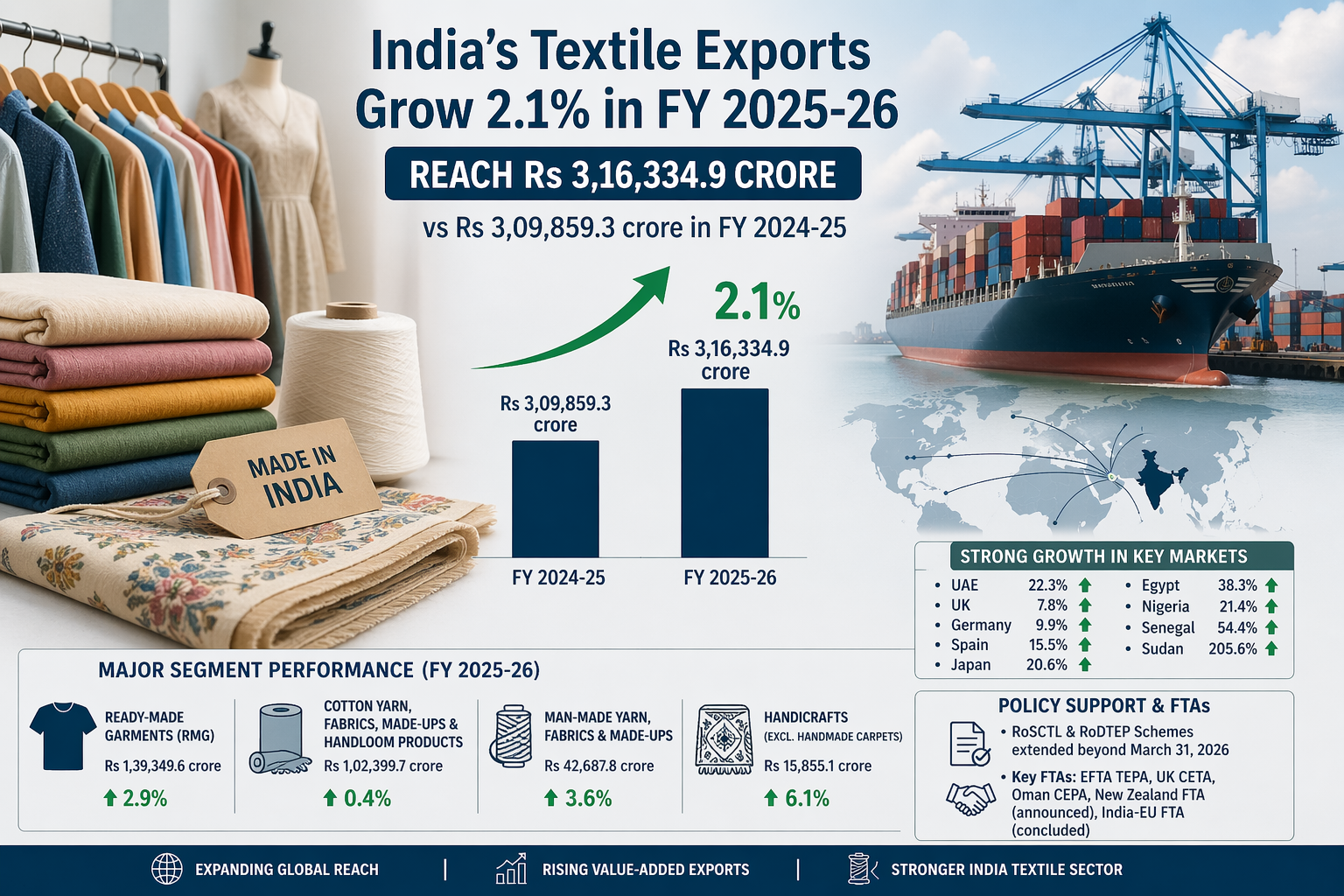
India’s textile exports, including handicrafts, continued to show resilience in FY 2025–26, posting a growth of 2.1 per cent to reach Rs 3,16,334.9 crore, compared to Rs 3,09,859.3 crore in the previous financial year, as per data released by the Ministry of Textiles on Wednesday.
This steady uptick reflects sustained global demand for Indian textile products and highlights the sector’s competitiveness across key segments, the ministry noted.
RMG leads; man-made segment gains traction
Ready-Made Garments (RMG) retained its position as the largest contributor to overall textile exports. The segment grew by 2.9 per cent, increasing from Rs 1,35,427.6 crore in FY 2024–25 to Rs 1,39,349.6 crore in FY 2025–26.
Cotton yarn, fabrics, made-ups and handloom products registered marginal growth of 0.4 per cent, rising from Rs 1,02,002.8 crore to Rs 1,02,399.7 crore. Meanwhile, the man-made yarn, fabrics and made-ups category outperformed with a growth of 3.6 per cent, reaching Rs 42,687.8 crore from Rs 41,196 crore.
Handicrafts emerge as key growth driver
In the value-added category, handicrafts excluding handmade carpets recorded the highest growth among major segments, expanding by 6.1 per cent from Rs 14,945.5 crore to Rs 15,855.1 crore.
The data further revealed that India’s textile exports expanded across more than 120 global destinations between April 2025 and February 2026, indicating a broad-based increase in market reach.
Notable growth was observed in key markets such as the United Arab Emirates (22.3 per cent), United Kingdom (7.8 per cent), Germany (9.9 per cent), Spain (15.5 per cent), Japan (20.6 per cent), Egypt (38.3 per cent), Nigeria (21.4 per cent), Senegal (54.4 per cent), and Sudan (205.6 per cent).
Policy push and FTAs to support growth
The government has extended key export support measures, including the Rebate of State and Central Taxes and Levies (RoSCTL) Scheme and the Remission of Duties and Taxes on Exported Products (RoDTEP) Scheme beyond March 31, 2026.
In parallel, India’s Free Trade Agreement (FTA) agenda progressed significantly during the year, with developments such as EFTA TEPA, UK CETA, Oman CEPA, the announcement of a New Zealand FTA, and the conclusion of the India–EU FTA. These initiatives are expected to enhance market access and strengthen India’s integration into global textile value chains.
The ministry stated that the sector’s continued export growth is driven by policy support, expanding global presence, and increasing demand for value-added textile products.


