

ESTÉE LAUDER COMPANIES ELC BIO-FERMENTATION BEAUTY INNOVATION COSMETIC INGREDIENTS SKINCARE INNOVATION BIOACTIVE INGREDIENTS PRECISION FERMENTATION SYNTHETIC BIOLOGY BEAUTY INDUSTRY COSMETICS INDUSTRY THE ORDINARY DECIEM ROSE HIP OIL FERMEN NATIONAL
GLOBAL
By IFAB MEDIA - NEWS BUREAU - October 30, 2026 | 140 10 minutes read





As the cosmetics industry continues to grow, so does the demand for new ingredients to help find skincare and beauty solutions. Bio-fermentation, which uses microorganisms as miniature production systems, is helping create bioactive ingredients that can do just that.
However, complexity of fermentation broths can prevent many promising concepts from being used for products.
“The industry has become pretty good at producing a molecule in a bioreactor,” says Leslie Ullmann, vice president of global microbiology and bio-fermentation at Estée Lauder Companies (ELC). “The real challenge is everything that comes after.”
ELC has created a development approach to move molecules into a stable, real-world beauty product.
Stopping to smell the rose hip oil
ELC put their model to the test when DECIEM, its subsidiary and creator of The Ordinary skincare brand, approached the bio-fermentation team about making a fully fermented version of rose hip oil. DECIEM requested that the new oil deliver distinct and enhanced activity. It also needed to have low odour, which is a common challenge with ferments.
Under a traditional development model, the project would move sequentially from discovery to testing to formulation, with each stage completed before the next began. Fermentation scientists would first produce the new ingredient, analytical chemists would characterize it, and formulation scientists would then create a market-ready product.
“Everything is step by step, and if something fails at the end of the process, you need to iterate and start over,” Ullmann says. “We’ve done that a lot, and you lose so much time.”
“Exciting ideas can lose relevance,” adds Gurleen Dhingra, a scientist in ELC’s bio-fermentation group.
ELC’s approach brings those scientists together from the start, allowing earlier and more frequent communication.
“As we developed the oil, we regularly shared samples with the analytical department and DECIEM’s formulators, and used their feedback to further refine it,” says Dhingra. Parameters related to media composition and fermentation were adjusted, until scent was within the acceptable range. “We did that until everyone was happy with it, without compromising activity.”
Why fermentation fails
Many challenges can stand in the way of bringing a cosmetic product to market. Secondary metabolites and other unwanted byproducts in a fermentation broth, for example, can affect not only scent, as in the rose oil example, but also colour and stability. Additional hurdles include ensuring a bioactive remains soluble, bioavailable and effective in the final formulation, while also meeting regulatory requirements. Left unresolved, these issues can increase costs, delay development and render an otherwise promising ferment commercially unviable.
“Those aesthetic attributes, how a product smells, looks and feels, they’re tremendous for us,” Ullmann says.
ELC developed its integrated model to identify such challenges earlier, before they become costly setbacks. Rather than moving projects sequentially from one team to the next, the company created parallel workstreams, or ‘vertically integrated loops’, that connect bio-fermentation, analytical and formulation scientists throughout development.
New ideas can enter the loop from multiple directions, with both fermentation and formulation teams proposing concepts for the other to assess. “There’s much more buy-in,” Dhingra says. “It helps move things along.”
Samples are also shared across teams much earlier than they would be under a traditional development model. Analytical chemists screen for unwanted byproducts, while formulators assess performance, compatibility and sensory attributes. As feedback comes in, the bio-fermentation team refines the process, generates new samples and continues tweaking. “It creates this highly collaborative environment where we can ask questions and solve problems in ways that we didn’t think about before,” Dhingra says.
Designing for success
Solubility is critical to many cosmetic products. ELC’s model allows the company to conduct early solubility screening, and when a water insoluble bioactive is flagged, the bio-fermentation team turns to their liposome technology for a solution.
“Our team can quickly work to encapsulate the ingredient into a liposome, solving the solubility issue, while working with analytical teams to make sure it’s still delivering what it needs to,” says Ullmann. “The formulation team is also involved to make sure it can be incorporated into the cream or lotion.”
Ullmann says that although projects may still start within fermentation, their work is not complete when handing it over to the next team. “We’re not waiting and finding out at the end that we developed this great molecule that doesn’t go into formulation.”

Pilot-scale fermentation helps scale bioactive ingredients towards commercial production.Credit: Jordan Tenenbaum

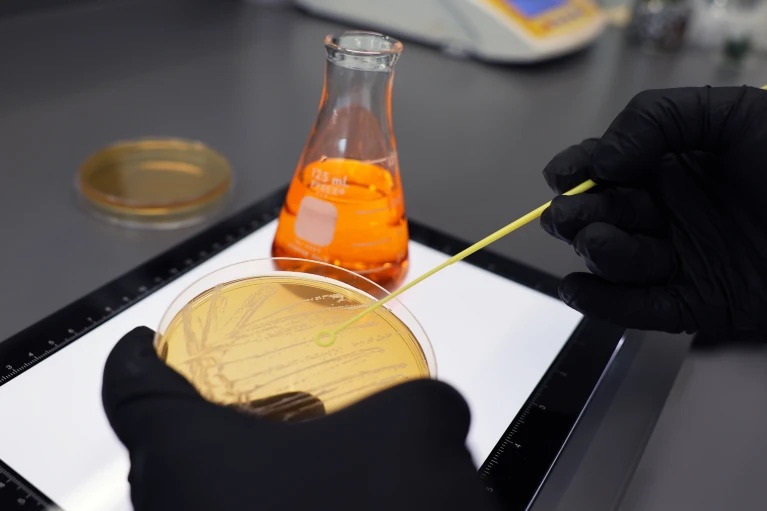
Researchers culture and screen microorganisms before transferring promising strains into fermentation systems.Credit: Estée Lauder Companies
The same principle applies to regulatory compliance. In cosmetic product development, Ullmann says it’s common for regulatory requirements to be treated as a late-stage checkpoint. But ELC considers global regulatory compliance an initial design constraint.
Take restrictions on furocoumarin levels. These compounds are common byproducts of citrus-based ferments and, when introduced to the skin and exposed to sunlight, can cause irritation. ELC treats this type of regulatory requirement as a design constraint at the start of a project.
“Sometimes people say, ‘You’re going to kill innovation by front-loading regulatory alignment,’” says Ullmann. “Butreally, you’re helping support innovation by pivoting to projects that can move forward. It’s making sure we’re betting on the right things.”
The future of cosmetics
Both Ullmann and Dhingra point to several advances on the horizon that may further expand the use of bio-fermentation-derived ingredients in cosmetics. Precision fermentation and synthetic biology could improve the ability to produce high-quality metabolites with defined activity, including molecules with low bioavailability. Artificial intelligence tools may also support ideation and predictive modelling, helping reduce trial and error and improve efficiency.
“As these tools mature, they will help us move faster,” says Ullmann.


