

RETAIL BUYING DEMAND UNCERTAINTY AI IN RETAIL DATA VS INTUITION FORECASTING LIMITATIONS MERCHANDISING STRATEGY ASSORTMENT PLANNING CAPITAL COMMITMENT ACCOUNTABILITY IN BUYING INVENTORY RISK MARKDOWNS UNSOLD STOCK JUDGMENT IN DECISION-MAKING F NATIONAL
MUMBAI, MAHARASHTRA, INDIA
By IFAB MEDIA - NEWS BUREAU - February 13, 2026 | 108 12 minutes read





Demand never shows up clean.
It never has. It never will.
By the time a buyer sees demand clearly, it’s usually already behind them. The numbers arrive late, smoothed, averaged, stripped of the irregularities that made the decision hard in the first place. Forecasts present confidence. Reality rarely agrees.
Retail lives inside this gap.
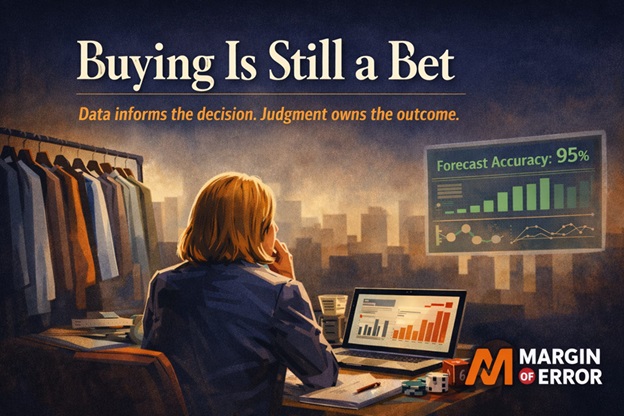
What has changed isn’t uncertainty. It’s how confidently uncertainty is now presented. Dashboards look sharper. Models feel smarter. AI narrows ranges, flags anomalies, highlights correlations humans would miss.
And still, the most important moment in retail buying remains stubbornly analogue.
Someone has to place the buy.
Data Was Never the Enemy
There’s a lazy argument that pits intuition against data, as if buyers are resisting progress. That framing is wrong.
Good buyers have always used data. Sell-throughs. Store-level performance. Seasonality. Miss rates. What AI has genuinely improved is speed, scale, and discipline. It spots inconsistencies early. It compresses uncertainty. It tells you, more confidently than before, where the edges are.
That matters.
AI is very good at narrowing the field. Excellent at telling you what is unlikely. Increasingly strong at flagging what deserves a second look. In assortments running into thousands of SKUs, this isn’t cosmetic. It avoids obvious mistakes. It saves time. It gives teams a shared reference point.
But none of that removes the bet.
Because in retail buying—especially fashion—you’re not just responding to demand. You’re deciding what will exist at all.
Buying Isn’t Prediction. It’s Creation.
This is where most writing on AI in retail misses the point.
Forecasting assumes demand already exists. Fashion buying often operates one step earlier. You’re choosing silhouettes, colours, fabrics, proportions. You’re deciding what shows up on a hanger, in a window, on a customer who hasn’t yet made up their mind.
That’s not prediction. That’s creation.
A model can tell you relaxed fits have been trending. It can show colour heatmaps. It can cluster preferences. But it can’t tell you whether this shade, in this fabric, at this price, will feel right six months from now.
At some point, the spreadsheet stops talking.
The buy doesn’t get signed by an algorithm. Capital does not move itself. Someone commits.
The irony is that as data gets better, that judgment becomes less visible.
A Familiar Tension, Long Before AI
There’s a moment I still remember clearly.
Back in 2007–08, I was working on setting up buying and merchandising processes at what was then the largest retailer in India. We were deploying one of the world’s most successful B&M systems. Consultants had flown in from across the globe.
What stood out wasn’t the technology. It was the conversation.
Buyers spoke in Excel. Ratios, cells, curves. They explained how spreadsheets gave them confidence and control. Then the consultants pushed back. They warned against hiding behind numbers. They spoke about how great buyers weren’t just analytical, but intuitive. How relying only on cold Excel could dull judgment rather than sharpen it.
Both sides were right. And both were incomplete.
What played out in that room wasn’t a debate about tools. It was an early version of the same question we’re still asking: where does judgment sit when systems grow powerful?
Rationalising Gut Is Not Replacing It
Buyers often talk about “making gut more rational.” That’s the real work.
Data doesn’t replace intuition. It disciplines it. It forces buyers to argue with themselves. To confront blind spots. Used well, data sharpens judgment.
Used poorly, it becomes cover.
I’ve seen both extremes.
I’ve also seen what happens when data is ignored entirely. A value retailer once decided to enter fashion aggressively. The logic appeared sound. White shirts. Universal. Affordable. Large volumes. Better sourcing economics.
What they missed wasn’t a forecasting variable. It was the customer.
Their core buyer wasn’t white-collar. These shirts moved slowly. Then stopped. For over two years, inventory sat. Eventually, it was given away free with grocery purchases.
This wasn’t intuition failing. It was unexamined belief masquerading as gut.
At the other end, I’ve watched teams over-analyse until the moment passes. Fashion doesn’t punish slowly. It punishes quietly.
Both paths end the same way: unsold stock.
When the Bet Fails, Ownership Thins
Markdowns follow. Clearance channels activate. Post-mortems are written.
What rarely gets addressed is simpler.
Who owned the decision?
In theory, everyone did. In practice, no one quite does once it fails.
“The system suggested…” “The model supported…” “The range was acceptable…”
Language shifts. Responsibility diffuses.
Unsold inventory is often explained analytically and owned emotionally by no one.
This isn’t a tooling problem. AI didn’t cause it. It exposed it.
When judgment is framed as a system outcome, learning becomes shallow. The same mistakes repeat, better justified the next time.
What Good Buyers Actually Do
The best buyers aren’t anti-data. They’re anti-abdication.
They know when they’re betting and say so. They use data to argue against themselves. They stay visible when things go wrong.
That visibility creates trust. Teams learn faster. Patterns get named honestly.
AI can make buying smarter. It cannot make it braver.
It cannot take responsibility.
The Bet Never Goes Away
AI will keep improving. Models will tighten. Noise will reduce.
Buying will remain a bet.
The real margin of error isn’t hidden inside the forecast. It sits in the moment someone commits capital—and whether they’re willing to own what follows.
Data informs. Judgment commits. Accountability absorbs.
That order hasn’t changed.
And no system will change it for you.

Follow Margin of Error on Substack : https://substack.com/@malaviyapuneet
Margin of Error Retail decision science. Where data ends and judgment begins.
 |
Puneet Malaviya - Lead Marketing, Raymond Lifestyle Ltd Puneet Malaviya is a distinguished marketing leader with nearly two decades of impactful experience in driving brand growth, customer engagement, and retail excellence across India’s consumer landscape. Currently a brand marketing lead for Raymond handling multiple brands like Ethnix by Raymond, Raymond Home & New Businesses Vertical at Raymond Lifestyle Ltd , Puneet is known for his strategic vision and ability to create meaningful brand experiences in the competitive fashion and lifestyle sector.
Over his accomplished career, Puneet has held senior leadership roles at prominent brands including Head of Marketing at TBZ – The Original and DGM – Marketing at Spencer’s Retail, where he played key roles in expanding market presence and strengthening brand value. His professional journey spans diverse domains such as customer relationship management, retail strategy, and omni-channel marketing, demonstrating both depth and breadth of expertise.
Puneet’s leadership has been instrumental in spearheading innovative campaigns and initiatives that resonate with consumers and deliver measurable results. His efforts contribute not only to business growth but also to enhancing brand relevance in a rapidly evolving market.
He holds a Post Graduate Diploma in Business Management (Marketing) from Chetana’s Institute of Management and a Bachelor of Science from the University of Allahabad, grounding his professional accomplishments in strong academic foundations. |
Disclaimer : The views, opinions, and insights expressed in this article are solely those of the author and do not necessarily reflect the official policy or position of IFAB Media or infashionbusiness.com. IFAB Media assumes no responsibility or liability for any errors, omissions, or representations in the content of this article. Readers are advised to independently verify the information provided before making any decisions based on its content.


