
DIGITAL KPI PARADOX VANITY METRICS DIGITAL RETAIL INDIA ECOMMERCE METRICS IMPRESSIONS AND REACH FOLLOWER COUNT EMAIL OPEN RATE CLICK THROUGH RATE ROAS CONVERSION RATE COST PER ACQUISITION CUSTOMER LIFETIME VALUE LTV CAC RATIO REPEAT PURCHASE NATIONAL
MUMBAI, MAHARASHTRA, INDIA
By IFAB MEDIA - NEWS BUREAU - March 9, 2026 | 105 26 minutes read





"The store is doing terribly." "But our Instagram reach is incredible!" Same company. Same week. Both true.
In Part 1, we exposed the beautiful lies of physical retail — footfall without conversion, loyalty programmes with no loyal customers, average bill values masking a collapsing base.
Now we move online. And here's the twist: the lies get prettier. The dashboards get fancier. The vanity metrics multiply. And the gap between what brands think is happening and what's actually happening gets wider by the quarter.
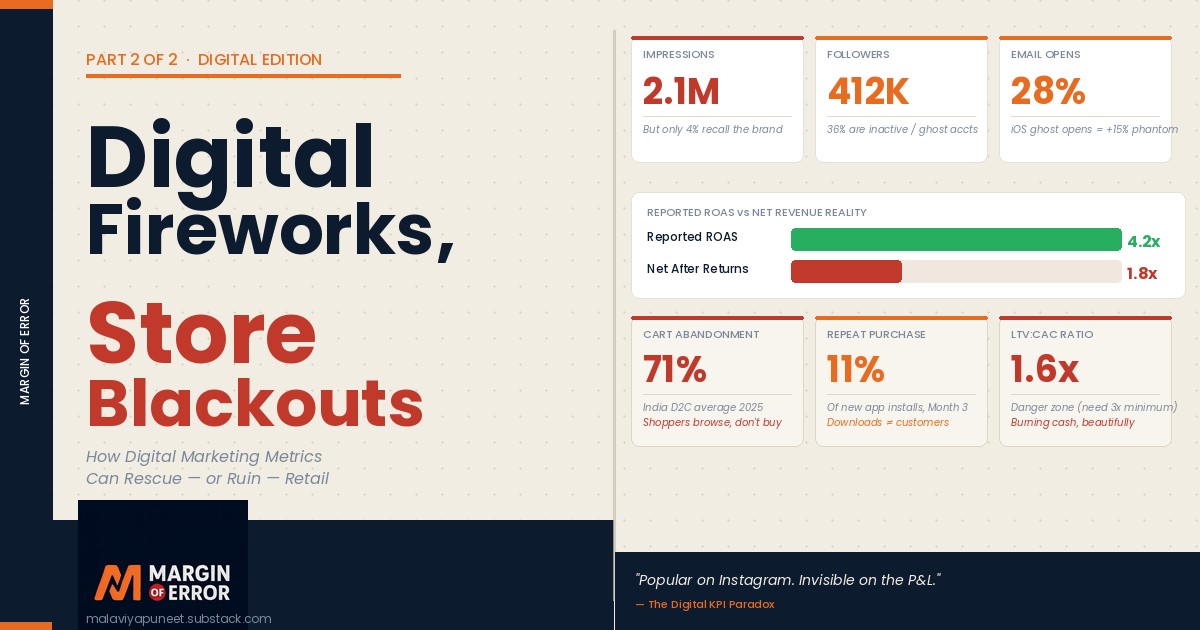
Welcome to the digital KPI paradox. Where a brand can have 400,000 followers, a 6% click-through rate, and a website that converts like a broken vending machine.
The Scene: A Digital Dashboard That Deserves an Oscar
Imagine the weekly marketing review. The CMO pulls up the deck:
- Website traffic: up 34% month-on-month.
- - Social media reach: 2.1 million impressions.
- - Email open rate: 28% — 'industry-leading.'
- - Influencer campaign: 800,000 views.
- - Actual online revenue: down 11%.
Silence. Someone refreshes the slide hoping the last number changes. It doesn't.
CMO: The awareness is clearly there. It's a conversion problem.
CFO: It's a revenue problem.
Everyone: ...whose problem is it, exactly?
Digital marketing's dirty secret: traffic is easy. Relevance is hard. Revenue is the truth nobody wants to read aloud.
India's Digital Retail Boom — With a Leaky Bucket
The scale of India's digital retail story is genuinely remarkable:
- India had 900 million internet users in 2025. That's an audience the size of several continents combined.
- E-commerce is on track for $350 billion by 2030, with fashion, beauty, and lifestyle leading the charge.
- Indian consumers now discover brands primarily through social media — Instagram, YouTube, and WhatsApp are the new shop windows.
But here's what the headline numbers don't show:
- - Cart abandonment rates hover between 65–80% on most Indian D2C platforms.
- - Average session durations on retail apps dropped 18% in 2024, even as app downloads rose.
- - Return rates on fashion e-commerce hit 30–40% in some categories — erasing margin even on completed sales.
The funnel is full at the top. The drain is wide open at the bottom.
The Digital Metrics That Lie Most Convincingly
1. Impressions & Reach
This is the 'footfall' of the digital world — and just as misleading. An impression means someone's screen displayed your ad for at least one second. It doesn't mean they saw it. It doesn't mean they cared. It doesn't mean they exist in your target demographic.
A brand running a saree campaign reaching 2 million 'users' in Delhi sounds great — until you learn 60% of the reach was outside the target age group, 25% was at 1am, and 15% was duplicate views from the same 200 accounts.
Reach isn't readership. Impressions aren't impact.
2. Follower Count
India's influencer ecosystem is magnificent, chaotic, and deeply gameable. A fashion brand with 500,000 Instagram followers feels like a media empire. But if 40% of those followers were accumulated through giveaways, paid follow-for-follow campaigns, or simply bought — you don't have a community. You have a number.
Follower count tells you where you've been. Engagement rate tells you whether anyone cares. And even engagement rate, in India's giveaway-driven ecosystem, is regularly manufactured.
"We went from 50K to 200K followers in a month." "Great. Did sales move?" "...We'll circle back."
3. Email Open Rate
28% open rate sounds like a marketing success story. And it might be — or it might be an artefact of Apple's Mail Privacy Protection, which pre-loads email pixels and records 'opens' whether or not a human being actually read the mail.
Since iOS 15, open rates across the industry have been inflated by 10–20 percentage points for Apple users, which in urban India represents a significant chunk of your premium segment.
If your open rates jumped 15% in late 2021 without changing anything — congratulations, you got a phantom audience.
4. ROAS (Return on Ad Spend)
ROAS is the metric the performance marketing team loves most and the CFO trusts least — and both instincts are correct.
A campaign showing 4x ROAS sounds like a winner. But ROAS typically measures last-click attribution. It ignores the 6 other touchpoints a customer had before clicking that final ad. It doesn't account for the customer who would have bought anyway. And it almost never nets out the cost of returns, refunds, or fraud — all of which run rampant in Indian e-commerce.
Net Revenue After Returns is the honest metric. Nobody wants to put that one in the deck.
The Digital Metrics That Actually Tell the Truth
The Honest Scorecard — Digital Edition
Impressions / Reach 2/10 ★☆☆☆☆
The Lie: "2 million people saw our brand!"
The Reality: 2 million screens displayed your ad. That's not the same thing. Without frequency control, viewability rates, and audience quality filters, reach is just expensive noise.
Follower Count 2/10 ★☆☆☆☆
The Lie: "We have a massive community."
The Reality: You have a list. Community means people who talk back, buy again, and recommend you to others. Follower count tells you almost nothing about any of that.
Email Open Rate 3/10 ★★☆☆☆
The Lie: "Industry-leading 28% open rate!"
The Reality: Post-iOS 15, this number is partially fictional for a significant portion of your list. Click-to-open rate (CTOR) is the honest signal. Open rate is now a confidence trick.
Click-Through Rate (CTR) 5/10 ★★★☆☆
The Lie: "People are clicking — they're interested!"
The Reality: CTR measures curiosity, not intent. High CTR with low conversion is just expensive window shopping. It's the digital equivalent of a packed mall with empty tills.
ROAS 5/10 ★★★☆☆
The Lie: "4x ROAS — our campaigns are crushing it."
The Reality: Last-click attribution gives all the credit to the final ad, ignoring everything that came before. Real ROAS, net of returns and fraud, is usually 30–50% lower than reported ROAS. Build that into your next deck.
Bounce Rate / Session Duration 6/10 ★★★☆☆
The Lie: "Low bounce rate means great UX."
The Reality: Not always. In India, bounce rates are inflated by slow page loads (especially on 4G in Tier-2 cities), poor mobile UX, and pop-ups that appear before the page loads. Fix the experience before reading the metric.
Conversion Rate (Digital) 7/10 ★★★★☆
The Lie: "Our conversion rate is 2% — that's the industry benchmark."
The Reality: Industry average doesn't mean industry gold standard. Best-in-class Indian D2C brands convert at 4–6%. If you're benchmarking to mediocrity, you'll comfortably stay mediocre.
Cost Per Acquisition (CPA) 8/10 ★★★★☆
The Lie: "We're acquiring customers at ₹400 CPA — excellent."
The Reality: Only excellent if ₹400 is well below your customer lifetime value. CPA without CLV context is meaningless. A brand spending ₹400 to acquire a customer worth ₹350 is burning cash, slowly, with great marketing.
Repeat Purchase Rate 9/10 ★★★★★
The Lie: "Our acquisition engine is strong; repeat is a bonus."
The Reality: Repeat purchase is not a bonus — it's the business. In India's D2C sector, first purchases are often loss-making. You make money on the second and third order. Brands that forget this fund their competitor's growth.
LTV:CAC Ratio 10/10 ★★★★★
The Lie: "We can't model that accurately enough."
The Reality: You can model it well enough to make better decisions. An LTV:CAC ratio below 3:1 is a warning signal. Below 2:1 is a crisis being disguised by growth metrics. This is the single most important number for sustainable digital retail.
Three Scenes from the Digital Shop Floor
Scene One: The Viral Post That Sold Nothing
A mid-size Indian ethnic wear brand posts a Navratri reel. Gorgeous production. Perfect music choice. The right influencer. The video hits 1.8 million views in four days.
The brand's Instagram following jumps 12,000 in a week. The founder tweets about 'organic growth.' The marketing team gets a round of applause.
Navratri sales that week: up 3%. The same as the previous year, without the viral post.
Real culprit: Viral reach without purchase intent. Entertainment ≠ conversion.
Scene Two: The ₹80 Lakh Influencer Campaign
A lifestyle brand spends ₹80 lakhs on 12 influencers across Instagram and YouTube over three months. The brief is brand awareness — no specific CTA, no discount code, no trackable link.
At the end of three months, the brand head asks: 'What did we get from this?'
The agency pulls up reach, impressions, and sentiment scores. All excellent. Direct revenue attributable to the campaign: unclear. 'It's awareness,' they explain. 'It works over time.'
Real culprit: No measurement framework built in from Day 1. Awareness without attribution is a story, not a strategy.
Scene Three: The App with Great Ratings and No Buyers
A D2C snacks brand launches an app. 4.6 stars on the Play Store. 50,000 downloads in the first month. App store featured placement. Covered in three startup publications.
Month 3 cohort data: only 11% of users who downloaded the app made a single purchase. Of those, 22% made a repeat purchase.
Real culprit: Downloads ≠ intent. Ratings measure satisfaction; cohort retention measures reality.
The Omnichannel Gap — Where Online and Offline Stop Talking
Here's where it gets genuinely complicated for Indian retail in 2025: the customer journey is omnichannel, but the measurement isn't.
A shopper discovers a kurta on Instagram. Reads reviews on YouTube. Checks the brand's website on mobile. Walks into the store on Saturday to touch the fabric. Buys it on Sunday via the app with a 10% first-order discount.
Which channel gets the credit? The Instagram ad says it does. The YouTube channel says it does. The store manager says the footfall converted. The app records the sale.
Digital Team: That was our campaign. Attribution confirmed.
Store Manager: She came to my store first. I converted her.
CFO: We counted her four times. How does that work?
Multi-touch attribution — actually understanding which touchpoints drive purchase — remains one of the most underinvested capabilities in Indian retail. Most brands run on last-click. Some run on first-click. Almost none run on the weighted models that actually reflect how customers make decisions.
The customer's journey is seamless. The brand's measurement is full of seams.
What Digital Retail Gets Wrong — And How to Fix It
- - Stop: Acquiring without modelling. Start: Build LTV:CAC into every campaign brief from Day 1. Not as a post-mortem metric. As a prerequisite.
- - Stop: Reporting inflated vanity metrics. Start: Measure CTOR, not open rate. Track cohort retention, not downloads. Report net revenue, not gross ROAS.
- - Stop: Untracked awareness campaigns. Start: Run every influencer campaign with a unique code, a trackable link, and a defined attribution window. No attribution, no renewal.
- - Stop: Single-channel attribution. Start: Map where customers discover, consider, and decide. Build measurement touchpoints at each stage.
- - Stop: Keeping digital and physical dashboards separate. Start: Every digital metric should have a physical analogue — and they should tell the same story. If they don't, something is broken.
The Real Question Every Retail Leader Should Ask
It's not 'What were our impressions this month?'
It's not 'How many followers did we gain?'
It's not even 'What was our ROAS?'
The real question — the one that builds businesses rather than decks — is this:
Of every rupee we spent acquiring a customer this quarter — how much will we earn from that customer over the next two years?
If you can answer that question confidently, your digital strategy is on solid ground.
If the room goes quiet when you ask it — the beautiful lies are still running the show.
Putting It All Together: The Series in Two Lines
Part 1: Retail is drawing crowds it isn't converting, building loyalty programmes that aren't building loyalty, and mistaking a busy dashboard for a healthy business.
Part 2: Digital retail is generating traffic it can't monetise, spending on awareness it can't attribute, and optimising for metrics that feel good but don't build margin.
Both problems have the same root: we've confused the dashboard for the destination.
Growth is easy to manufacture. Love — the kind that brings customers back, unprompted, and sends their friends — is not.
That's the only metric that ultimately matters. And it doesn't fit neatly in any chart.
If this landed, share it with someone who still measures success in impressions.
And if you've lived through your own beautiful lie — drop it in the comments. Let's decode it together.
Credit Lines : Disclaimer : The views, opinions, and insights expressed in this article are solely those of the author and do not necessarily reflect the official policy or position of IFAB Media or infashionbusiness.com. IFAB Media assumes no responsibility or liabili
 |
Puneet Malaviya - Lead Marketing, Raymond Lifestyle Ltd Puneet Malaviya is a distinguished marketing leader with nearly two decades of impactful experience in driving brand growth, customer engagement, and retail excellence across India’s consumer landscape. Currently a brand marketing lead for Raymond handling multiple brands like Ethnix by Raymond, Raymond Home & New Businesses Vertical at Raymond Lifestyle Ltd , Puneet is known for his strategic vision and ability to create meaningful brand experiences in the competitive fashion and lifestyle sector.
Over his accomplished career, Puneet has held senior leadership roles at prominent brands including Head of Marketing at TBZ – The Original and DGM – Marketing at Spencer’s Retail, where he played key roles in expanding market presence and strengthening brand value. His professional journey spans diverse domains such as customer relationship management, retail strategy, and omni-channel marketing, demonstrating both depth and breadth of expertise.
Puneet’s leadership has been instrumental in spearheading innovative campaigns and initiatives that resonate with consumers and deliver measurable results. His efforts contribute not only to business growth but also to enhancing brand relevance in a rapidly evolving market.
He holds a Post Graduate Diploma in Business Management (Marketing) from Chetana’s Institute of Management and a Bachelor of Science from the University of Allahabad, grounding his professional accomplishments in strong academic foundations. |
Follow Margin of Error on Substack : https://substack.com/@malaviyapuneet Margin of Error Retail decision science. Where data ends and judgment begins.