
PLAYSTATION NORTH BOMBAY STORE OPENING BRAND IDENTITY SONIC IDENTITY GAMING CULTURE BRAND ACTIVATION DHOL TASHA CUSTOMER EXPERIENCE DIFFERENTIATION MARKETING STRATEGY LUXURY RETAIL CLASSICAL PERFORMANCE SITAR CURATION BRAND DNA ETHNIC WEAR NATIONAL
MUMBAI, MAHARASHTRA, INDIA
By IFAB MEDIA - NEWS BUREAU - April 26, 2026 | 238 12 minutes read





PlayStation opened a store in North Bombay recently.
A console brand. A brand with its own sonic identity, visual language, controller haptics, gaming culture, franchise mythology, and a global tribe that has been building rituals around it for three decades.
They opened with dhol-tasha.
Not bad dhol-tasha.
Just dhol-tasha that could have been anywhere, for anyone, for any brand.
The performance ended.
The brand had said nothing it could call its own.
— — —
That is the problem. Not the choice. The absence of a question.
What should this feel like to someone who has been playing since they were twelve?
What sound belongs in this room?
What moment would make the first customer feel seen?
Nobody asked.
Because nobody needed to.
There was already an answer.
Local cultural performance. Photo moment. Move on.
— — —
This is what muscle memory looks like in marketing.
The brief gets answered.
The vendor gets booked.
The box gets ticked.
And the brand spends real money to generate zero differentiation.
— — —
Now go to a luxury boutique opening.
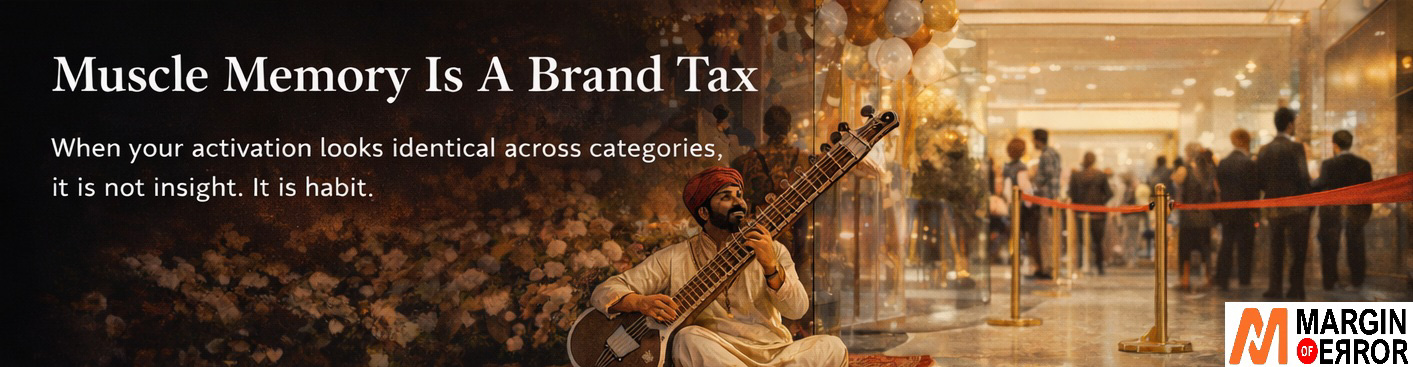
Sitar player at the entrance. Or a classical dance performance in the atrium.
The logic is coherent, if you do not examine it.
Luxury equals culture. Culture equals classical arts. Classical arts at the door. Done.
Except the brand spent years building a design language. A point of view. A reason to exist.
And the first thing a customer experiences is something completely interchangeable.
The sitar player will pack up and go to the next one next week.
The customer walks in having been told nothing.
Luxury is built on exclusion.
The launch was completely interchangeable.
Curation is the product.
The entry moment is the first edit.
They handed that edit to habit.
— — —
The sharpest version of this is ethnic wear.
A brand in this category is not adjacent to culture.
The brand is culture.
Regional craft. Local artisanship. Specificity of occasion, community, memory.
That is the product.
That is the margin.
So when a store opens in Mumbai, or Bangalore, or Delhi, what happens?
Garba. Or Ghoomar.
Regardless of city.
Regardless of customer.
Regardless of which tradition the brand is actually built on.
India becomes one cultural bucket.
The brand that sells specificity activates generically.
The store opening says the opposite of what the product promises.
— — —
Three categories. Three completely different brand DNA.
Identical activation logic.
PlayStation could have activated through sound, play, nostalgia, community.
The luxury boutique could have activated through design, material, point of view.
The ethnic wear brand could have activated through the specific craft and community it represents.
They chose a template.
— — —
The template is not the problem.
The unquestioned template is the problem.
Ritual becomes muscle memory when it loses the question it was originally answering.
Someone once decided a store opening needed energy, engagement, a cultural moment.
That was probably right.
For a specific brand. In a specific context.
Then the decision became a process.
The process became a checklist.
The checklist became the answer.
— — —
The cost never shows up in the activation budget.
It shows up in what the customer does not remember.
It shows up in the absence of a story.
In the sameness of experience.
In the next brief: let us do what we did last time.
— — —
Customers never experience strategy.
They experience the gap between what was designed and what actually happened.
When nothing was actually designed, the gap is everything.
— — —
When execution looks identical across categories, it is not insight. It is habit.
The question is not whether your activation worked.
Most activations work.
The crowd gathered. The photos were taken. The launch happened.
The question is:
What did your brand say that only your brand could have said, in that moment, to those specific people?
If the answer is nothing,
you did not activate your brand.
You executed a habit. Not a brand.
 |
Puneet Malaviya - Lead Marketing, Raymond Lifestyle Ltd Puneet Malaviya is a distinguished marketing leader with nearly two decades of impactful experience in driving brand growth, customer engagement, and retail excellence across India’s consumer landscape. Currently a brand marketing lead for Raymond handling multiple brands like Ethnix by Raymond, Raymond Home & New Businesses Vertical at Raymond Lifestyle Ltd , Puneet is known for his strategic vision and ability to create meaningful brand experiences in the competitive fashion and lifestyle sector.
Over his accomplished career, Puneet has held senior leadership roles at prominent brands including Head of Marketing at TBZ – The Original and DGM – Marketing at Spencer’s Retail, where he played key roles in expanding market presence and strengthening brand value. His professional journey spans diverse domains such as customer relationship management, retail strategy, and omni-channel marketing, demonstrating both depth and breadth of expertise.
Puneet’s leadership has been instrumental in spearheading innovative campaigns and initiatives that resonate with consumers and deliver measurable results. His efforts contribute not only to business growth but also to enhancing brand relevance in a rapidly evolving market.
He holds a Post Graduate Diploma in Business Management (Marketing) from Chetana’s Institute of Management and a Bachelor of Science from the University of Allahabad, grounding his professional accomplishments in strong academic foundations. |
Follow Margin of Error on Substack : https://substack.com/@malaviyapuneet Margin of Error Retail decision science. Where data ends and judgment begins.