

UPI MERCHANT DISCOUNT RATE MDR UPI MDR DIGITAL PAYMENTS UPI TRANSACTIONS PERSON-TO-MERCHANT P2M PERSON-TO-PERSON P2P RETAIL PAYMENTS FASHION RETAIL FASHION INDUSTRY APPAREL RETAIL RETAIL INDUSTRY FESTIVE SEASON FESTIVE SHOPPING MERCHANTS NATIONAL
MUMBAI, MAHARASHTRA, INDIA
By IFAB MEDIA - NEWS BUREAU - September 17, 2026 | 553 16 minutes read





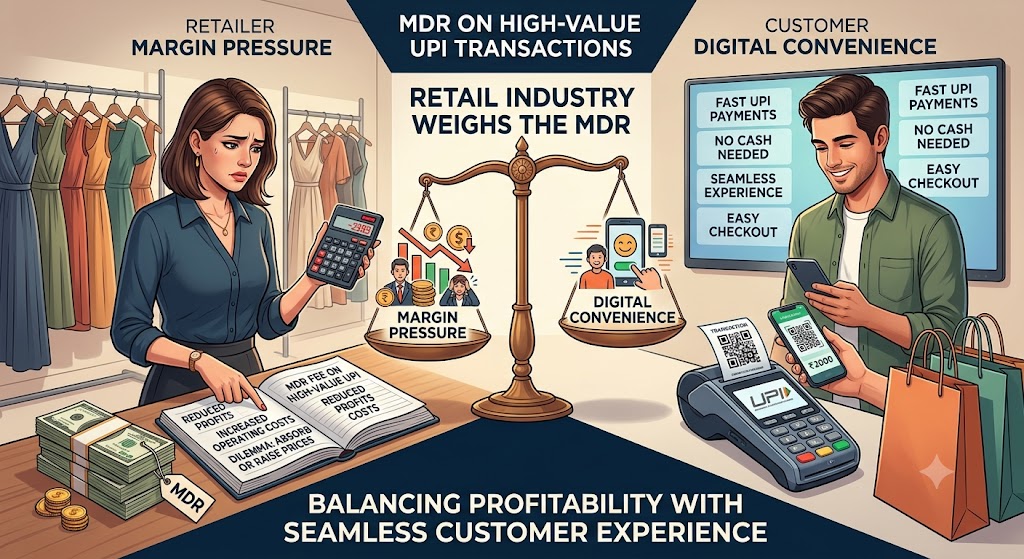
The introduction of a Merchant Discount Rate (MDR) on select high-value UPI transactions has opened a fresh debate across India’s fashion and retail industry, coming just as businesses enter the crucial festive shopping period. From October 15, 2026, a 0.4% MDR will apply to specified Person-to-Merchant (P2M) UPI transactions above ₹2,000, with the charge capped at ₹300 for transactions of ₹75,000 and above. Consumers will not be charged the MDR directly, while Person-to-Person transactions and P2M transactions up to ₹2,000 will remain free. The government has said that approximately 96% of merchant transactions will remain unaffected under the new framework.
The change is significant because UPI has become deeply embedded in India’s retail payment ecosystem. After several years in which UPI merchant transactions operated without MDR, the new framework introduces a cost for certain higher-value merchant payments. For fashion and apparel retailers, the issue is therefore not a direct charge to the consumer, but how the additional payment cost will be absorbed at a time when festive-season volumes, promotional spending and competitive pricing are already putting pressure on margins.
The government has positioned the framework as a measure aimed at supporting the long-term sustainability of the digital payments ecosystem. The framework keeps P2P transactions free, protects P2M transactions up to ₹2,000 and provides a zero-MDR framework for specified small merchants. The MDR itself is described by the government as a charge within the merchant payment ecosystem rather than a tax collected by the government or NPCI.
For the retail industry, however, the debate is increasingly focused on the economics of accepting digital payments and whether the additional cost will ultimately affect merchant profitability, promotional strategies or payment behaviour.
For the fashion industry, the timing has become an important part of the discussion. Festive shopping typically brings higher ticket sizes, while brands and retailers simultaneously increase spending on advertising, promotions, discounts, inventory and customer acquisition. Even a small transaction-level cost can become meaningful when applied across thousands of higher-value transactions.

Santosh Katariya, President, Clothing Manufacturers Association of India (CMAI), said:
“Introducing MDR on UPI at the start of festive season could not have come at a more challenging time for the industry. This period is critical for merchants, retailers and consumer-facing businesses, many of whom are already working hard to revive demand and improve margins. Adding another cost to digital transactions at this juncture risks putting further pressure on an ecosystem that is still finding its footing. UPI has been a powerful enabler of consumption and formalization and any move that increases the cost of acceptance needs to be carefully calibrated, particularly during the most important sales period of the year.”
At the same time, there is a view within the retail and mall ecosystem that the new MDR may not materially alter consumer behaviour because the charge is not being imposed directly on shoppers.

Susil S DUNGARWAL, Chief Mall Mechanic, Beyond Squarefeet, a Shopping Mall Advisory company, said:
“The proposed MDR is quite low and affordable, compared to the convenience it offers, compared to any other forms of payments. I don’t think, this can be a spoiler to the upcoming festive season.”
The distinction between consumer experience and merchant economics remains central to the debate. For consumers, the immediate payment experience remains largely unchanged because they are not directly charged MDR. For retailers, however, eligible transactions above ₹2,000 create an additional cost that has to be factored into the economics of the sale. The government has specifically directed that MDR should not be passed on to consumers.

Agnes Raja George, Founder of De Moza, said:
“I don’t see this as a major disruption to consumption because the charge is not being passed directly to the consumer. From a customer point of view, UPI will continue to remain a convenient and preferred mode of payment”.
Agnes Raja George further said:“The impact will be more on the business side. Retailers and other merchants may have to absorb an additional payment cost, especially in categories where the average transaction value is higher. For larger retailers, this may not change customer behaviour significantly, but it does add another cost line that needs to be managed.
Most organised retailers are already used to paying transaction or platform charges across cards, payment gateways and aggregators. So I see this more as profitability and cost-optimisation issue rather than a demand issue.
Companies will have to look at improving efficiencies in other areas such as inventory, operating costs, payment negotiations and overall margin management to absorb the additional expense without passing it on to customers.
Overall, I don’t expect this to materially impact consumption, but it will put some additional pressure on retailer margins, particularly in businesses operating on already tight profitability.”
The potential impact across the business can be understood across four key dimensions:
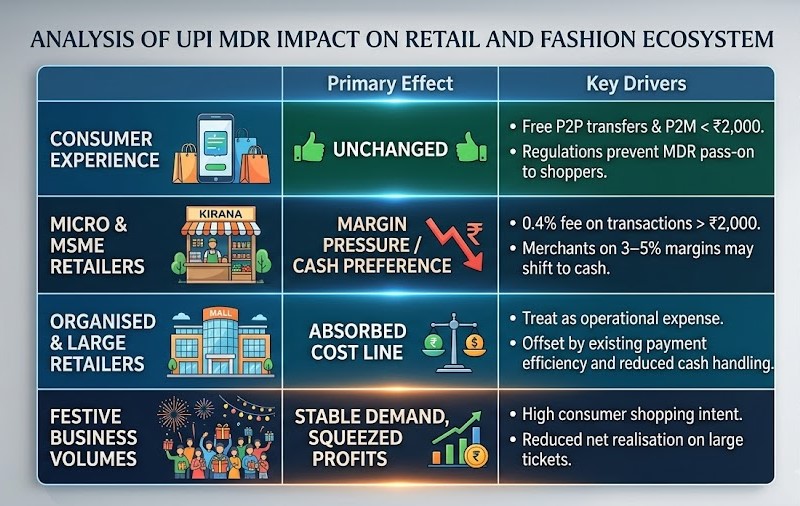
The mathematics of the MDR also illustrates why the issue becomes more relevant as transaction values rise. A 0.4% charge translates into ₹8 on a ₹2,000 transaction, ₹40 on a ₹10,000 transaction and ₹200 on a ₹50,000 transaction, with the MDR capped at ₹300 for transactions of ₹75,000 and above.
For organised retailers handling large transaction volumes, the additional cost may become another operational line item, to be weighed against existing payment costs and the savings associated with reduced cash handling. For smaller businesses, where margins are tighter, the same percentage can have a more noticeable impact on profitability.

Lakhbir Singh, President – Killer, Easies & Junior Killer, Kewal Kiran Clothing Limited (KKCL), said:
“The introduction of MDR on UPI transactions will certainly add some incremental cost pressure on retailers, particularly in fashion where transaction values are relatively higher. Coming at the start of the festive season, when brands are already investing heavily in promotions and consumer offers, even a small additional transaction cost can impact margins when multiplied across volumes.
At the same time, UPI has transformed retail payments in India and made transactions extremely convenient for consumers. The industry would therefore expect a balanced approach that ensures the sustainability of the digital payment ecosystem without putting disproportionate pressure on merchants or affecting the momentum of consumer spending.”
 Akhil Jain, CEO - Madame, said:
“Sooner or later, the introduction of MDR on UPI transactions had to happen as the ecosystem matures. For customers, UPI has become synonymous with convenience and seamless payments, and that experience should remain unaffected. The real question is how the additional cost is absorbed across the ecosystem. For retailers, particularly during the festive season when transaction volumes are high, the impact will depend on the MDR structure and its eventual cost to the business. If managed well, this can be a natural evolution of the payments ecosystem without compromising the ease and convenience customers have come to expect.”

Taranpreet Singh, Founder & Managing Partner, Expansion Masters LLP, TRS Consultancy, said:
“For small and mid-sized retailers, the 0.4% MDR lands at the worst possible moment — right as festive-season ticket sizes cross the ₹2,000 threshold where it applies. On thin margins, that's not a rounding error; it's a real incentive to steer customers back to cash, undoing years of digital adoption just when merchants should be scaling up for the season's peak."
The festive season could consequently become an important test of how retailers respond to the new payment economics. Strong shopper intent may sustain transaction volumes across fashion, apparel and lifestyle categories, but businesses will have to factor the additional cost into their margin calculations. The impact is therefore likely to vary according to transaction values, merchant size, operating margins and the extent to which businesses can absorb payment-related expenses.
Industry sentiment also indicates that merchant willingness to absorb MDR may be limited. A LocalCircles survey reported by Business Standard found that 41% of respondents said they would not bear any MDR on UPI payments above ₹2,000, while only 17% said they were willing to bear a 0.4% MDR. The survey reflects merchant sentiment rather than a forecast of actual payment behaviour.
The Retailers Association of India (RAI), however, has raised concerns over the potential impact on smaller retailers, particularly the possibility that merchants could encourage customers to move higher-value purchases back towards cash. RAI has said it will take up the matter with NPCI and the Ministry of Finance.

Kumar Rajagopalan, CEO, Retailers Association of India, said:
“Small merchants will now think twice about whether to accept cash or UPI,” said Kumar Rajagopalan, CEO, Retailers Association of India. “During the festive season, a large share of transactions crosses the Rs 2,000 mark, and the moment a fee attaches itself to digital payment, cash becomes the path of least resistance.”
RAI's concern extends past retailer margins. Every transaction that slips off the UPI rail and back into cash disappears from the formal trail that feeds GST reporting, the opposite of what a decade of digitisation policy has tried to build. “This cuts against the government's own formalisation agenda,” Kumar Rajagopalan said. “UPI acceptance should be incentivised, not taxed.”
RAI also pushed back on treating all UPI transactions as one category. Most UPI payments draw directly from a savings or current account — the digital equivalent of a debit transaction, carrying none of the interchange cost or credit risk that justifies a fee on credit networks. “We don't see the case for charging a bank-to-bank UPI payment the way you'd charge for credit,” Rajagopalan said. “Where UPI is linked to a credit line, a fee is easier to defend, because the cost structure genuinely resembles a credit product. We urge that the government should bear the cost of normal UPI transactions since it repays the government with GST and traceable transactions instead of cash transactions.”
That case extends to who ultimately funds the rail itself. “NPCI keeps UPI running for the entire country — RBI or the government should be underwriting that cost, not merchants,” Rajagopalan said. “The state gets a formal, traceable transaction it can tax out of every UPI payment. It should be paying for the enablement, not passing the bill down to the smallest retailer in the chain.”
RAI said it will take up the matter with the National Payments Corporation of India and the Ministry of Finance, pressing for a graded structure that separates debit-linked from credit-linked UPI transactions and pairs any merchant charge with incentives that keep small retailers inside the formal payment system rather than pushing them out of it.
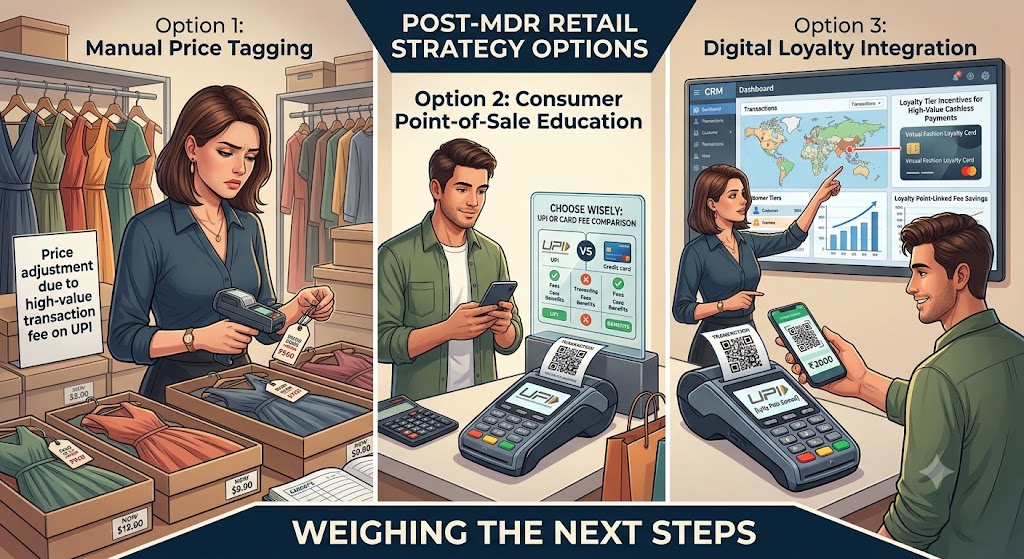
The introduction of MDR therefore places fashion and retail businesses in a new cost-management environment as they head into the festive season. While the consumer-facing UPI experience remains centred on convenience and transactions up to ₹2,000 remain outside the standard MDR, merchants now have to account for an additional cost on eligible higher-value payments.
For organised retailers, the 0.4% MDR may become another operational cost to be balanced against payment convenience, cash-handling costs, promotional investments and overall margins. For smaller retailers, the impact could be more pronounced where transaction values regularly cross the threshold and operating margins leave less room to absorb additional costs.
The larger question is how the economics of digital payments will evolve without weakening merchant participation or the convenience that has made UPI an integral part of Indian commerce. As fashion and retail businesses enter the festive season, the industry's response will be shaped by transaction volumes, margins, payment costs and the ability of individual businesses to absorb the additional expense while maintaining competitive offers for consumers.
Credit Lines : Disclaimer: The views, opinions, and insights expressed in this article are solely of the spokespersons quoted in the story and do not necessarily reflect the official position of IFAB Media or infashionbusiness.com.


